
Published by Dr. Tatiana Nikolaeva
For skin health, bee venom stimulates collagen production, Manuka honey provides antibacterial and hydrating benefits, propolis accelerates healing and fights infection, and royal jelly nourishes skin from the inside with vitamins and fatty acids. Used together or individually, bee products offer a comprehensive, natural approach to skin care backed by scientific research.
Your skin is your body's largest organ, and what you put on it and into your body both matter. Bee products offer a unique combination of topical and internal skin support that synthetic ingredients can't fully replicate. Here's how each one works and how to build a bee-based skincare routine.
This article is educational and is not a substitute for medical advice. Always follow product labels and speak with a qualified health professional for personal health concerns.
Bee Venom: Nature's Collagen Booster
Bee venom has earned the nickname "nature's Botox", though the mechanism is completely different. When applied to skin, bee venom:
- Stimulates collagen and elastin production: the proteins that keep skin firm and elastic
- Increases blood circulation: delivering more oxygen and nutrients to skin cells
- Creates a mild tightening effect: through the skin's natural response to the venom's peptides
- Reduces inflammation: melittin suppresses inflammatory pathways that contribute to skin ageing
Best for: Anti-ageing, fine lines, loss of firmness, dull skin
How to use: Bee venom face creams and masks are the most common delivery method. Apply as part of your evening skincare routine. Start with 2-3 times per week to let your skin adjust, then move to daily use if tolerated well.
Explore our VENZ bee venom range: including skincare formulations made with purified NZ bee venom.
Manuka Honey: Antibacterial Hydration
Manuka honey benefits skin through multiple pathways:
- Antibacterial MGO: kills acne-causing bacteria without disrupting the skin microbiome
- Natural humectant: draws moisture into the skin and locks it in
- inflammatory response support: reduces redness and irritation from conditions like eczema, rosacea, and acne
- Wound healing: promotes clean tissue repair and may reduce scarring
Best for: Acne, eczema, dry skin, wound healing, general hydration
How to use: Apply raw UMF 15+ as a face mask (15-20 minutes, rinse off), or use formulated Manuka skincare products daily. Read our full guide: Manuka Honey Skincare.
Propolis: supports recovery and Protect
Propolis is the hive's defence system, and it works similarly on skin:
- Antimicrobial protection: fights bacteria, fungi, and viruses on the skin surface
- Accelerated healing: stimulates tissue repair and cell regeneration
- inflammatory response support: reduces swelling and redness from breakouts or irritation
- Antioxidant: flavonoids in propolis protect against UV-related free radical damage
Best for: Acne, blemishes, minor wounds, cold sores, post-blemish healing
How to use: Propolis tincture can be applied directly to blemishes as a spot treatment. Propolis-enriched creams and balms provide broader skin protection. For cold sores, apply propolis ointment at the first sign of tingling.
Royal Jelly: Nourish From Within
Royal jelly supports skin health internally through its unique nutritional profile:
- 10-HDA (10-Hydroxy-2-decenoic acid): a fatty acid unique to royal jelly that supports collagen production and has antimicrobial properties
- B vitamins: especially B5 (pantothenic acid), which is essential for skin cell renewal and moisture retention
- Amino acids: the building blocks of skin proteins
- Royalactin: a protein that stimulates cell growth and regeneration
Best for: Overall skin nutrition, anti-ageing from the inside, dry or tired skin, supporting skin repair
How to use: Take fresh royal jelly (1/4 to 1/2 teaspoon daily) on an empty stomach, or in capsule form. Topical royal jelly products are also available for direct skin application.
Bee Pollen: The Nutritional Foundation
Bee pollen contributes to skin health through overall nutrition:
- Zinc and selenium: minerals essential for skin repair and protection
- Vitamins A, C, and E: key antioxidant vitamins for skin health
- Complete amino acids: supports protein synthesis including collagen and keratin
- Rutin and quercetin: flavonoids that protect blood vessels and reduce inflammation
Best for: Supporting skin health from the inside, filling nutritional gaps that affect skin quality
How to use: 1-2 teaspoons of bee pollen granules daily, sprinkled on food or blended into smoothies.
Building a Bee-Based Skincare Routine
| Goal | Topical | Internal |
|---|---|---|
| Anti-ageing | Bee venom cream + Manuka honey mask | Royal jelly + bee pollen |
| Acne | Manuka honey mask + propolis spot treatment | Propolis capsules + bee pollen |
| Dry / sensitive skin | Manuka honey mask + bee venom cream | Royal jelly + bee pollen |
| General glow | Weekly Manuka honey mask | Bee pollen + royal jelly daily |
| Healing / repair | Manuka honey + propolis on affected area | Propolis capsules for immune support |
Frequently Asked Questions
Which single bee product is best for skin?
If you could only choose one, Manuka honey offers the broadest range of skin benefits, antibacterial, inflammatory response support, moisturising, and healing. For specifically anti-ageing concerns, bee venom is more targeted. For internal skin nutrition, royal jelly is the strongest choice.
Can I use bee products if I have sensitive skin?
Yes: Manuka honey and propolis are generally well-tolerated by sensitive skin due to their inflammatory-response-supporting properties. Bee venom products may cause a mild tingling sensation; start with patch testing. Always introduce one new product at a time and wait 48 hours before adding another.
How long before I see results?
Hydration benefits from Manuka honey are immediate (one mask session). inflammatory-response-supporting benefits typically show within 1-2 weeks of consistent use. Anti-ageing benefits from bee venom and royal jelly typically take 4-8 weeks of regular use to become noticeable. Skin cell turnover is roughly 28 days, so give any new product at least one full cycle.
Are bee product skincare ingredients natural?
Bee products are entirely natural, produced by bees from flowers, tree resins, and their own glandular secretions. However, formulated skincare products may contain other ingredients alongside the bee components. Check ingredient lists if you prefer fully natural formulations.
Can I combine bee products with my existing skincare routine?
Yes. Bee products work well alongside most conventional skincare ingredients, retinol, vitamin C, niacinamide, and hyaluronic acid are all compatible. Avoid applying Manuka honey masks immediately after strong chemical exfoliants (AHAs/BHAs) on sensitive skin. Otherwise, bee products integrate easily into any routine.
The Bottom Line
Bee products offer a complete natural skincare toolkit: bee venom for collagen, Manuka honey for hydration and bacteria, propolis for healing, royal jelly for internal nourishment, and bee pollen for foundational nutrition. Used alone or combined, they deliver science-backed skin benefits from both outside and inside.
Explore our skincare range: Manuka honey, bee venom, and propolis formulations made in New Zealand.
About the author
Dr. Tatiana Nikolaeva
Co-founder & Product Researcher, ApiHealth NZ
Dr. Tatiana Nikolaeva works alongside the ApiHealth research team in New Zealand, focusing on natural formulations across the company’s bee-derived wellness and skincare ranges. She writes on Manuka honey, bee pollen and everyday natural wellness.
More about the ApiHealth teamKey Ingredients
Related Articles
View all
Bee Products for Longevity: How Manuka Honey, VENZ™, Propolis and Royal Jelly Support Healthy Ageing
Manuka honey, bee venom, propolis and royal jelly are often grouped together as bee products for longevity. Here is what the science says about each one.
Bee Products for Women's Health: What the Science Suggests
A simple, science-aware guide to bee products for women's health: royal jelly, bee pollen and propolis for hormonal balance, energy and daily wellness.
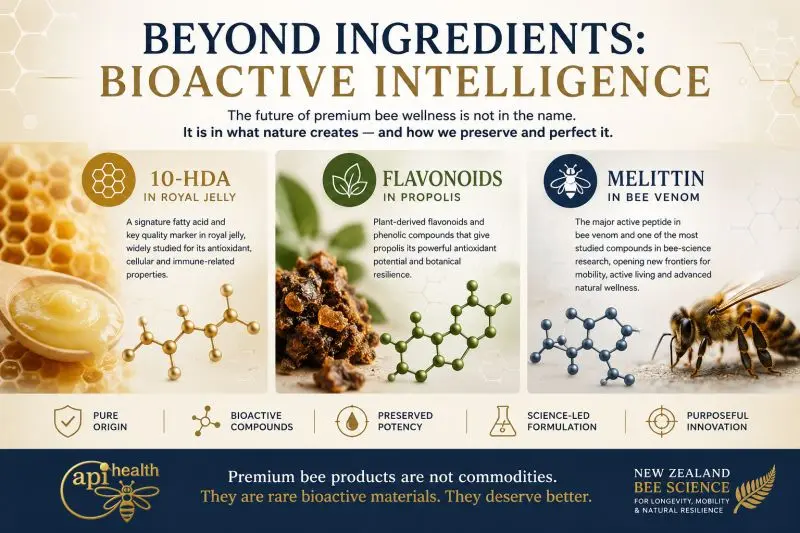
Beyond Ingredients: The Bioactive Compounds in Bee Products
A clear look at the bioactive compounds in bee products: 10-HDA in royal jelly, flavonoids in propolis, and melittin in bee venom, and why preservation matters.
Shop ApiHealth
Ready to bring the hive home?
Explore our New Zealand-made Manuka honey, VENZ bee venom, propolis and natural wellness range, crafted by our family of beekeepers and researchers.